

This guide explains Roth IRA contribution limits 2026 in plain language. For 2026, the combined traditional and Roth IRA contribution limit is $7,500, or $8,600 when the saver is age 50 or older. That is a planning limit per person, not $7,500 for each IRA. You need taxable compensation, and a direct Roth contribution may be reduced when modified adjusted gross income falls inside the phase-out range for your filing status. The figures explain these boundaries; use the Roth IRA calculator as an estimate, not a tax determination.
START HERE
The 2026 rule has four separate checks
A contribution limit is not one single number for every taxpayer. Start with the annual IRA cap, then check your age, taxable compensation, other IRA deposits and modified AGI. The IRS applies the annual cap across your traditional and Roth IRAs combined. A contribution to one account leaves less room in the other account.
Roth income rules affect direct contributions only. A rollover or a Roth conversion is a different transaction and is not extra annual contribution room. A person above the direct-contribution phase-out range may need a different planning discussion, but this guide does not calculate a conversion, a backdoor Roth, or your final tax bill.
- Annual limit: $7,500 under age 50, or $8,600 at age 50 or older.
- Compensation cap: total IRA contributions cannot exceed taxable compensation for the year.
- Shared limit: traditional and Roth IRA deposits use the same annual pool.
- Income test: MAGI can reduce or eliminate a direct Roth contribution.
- Timing: the contribution deadline is generally the tax-filing deadline for the following year.
ANNUAL CAP
Roth IRA contribution limits 2026 and catch-up amount
The IRS says total contributions to all of your traditional and Roth IRAs cannot exceed $7,500 for 2026, or $8,600 if you are age 50 or older. The extra $1,100 is the age-50 catch-up amount. The cap is per individual, so a married couple can have two separate limits when each spouse qualifies and has enough compensation under the applicable rules.
The annual cap is the starting point, not a promise that a Roth account can receive the full amount. If you earn less than the cap in taxable compensation, your compensation becomes the ceiling. If you already put money into a traditional IRA, subtract that amount before deciding how much remains for a Roth IRA.
| Situation | Maximum across all IRAs | Planning note |
|---|---|---|
| Under age 50 | $7,500 | Traditional and Roth deposits share this amount. |
| Age 50 or older | $8,600 | Includes the $1,100 catch-up amount. |
| Taxable compensation below the cap | Your compensation | The lower amount controls. |
| Rollover contribution | Not counted in this annual cap | A rollover is different from a regular contribution. |
INCOME TEST
2026 Roth IRA income limits and phase-out ranges
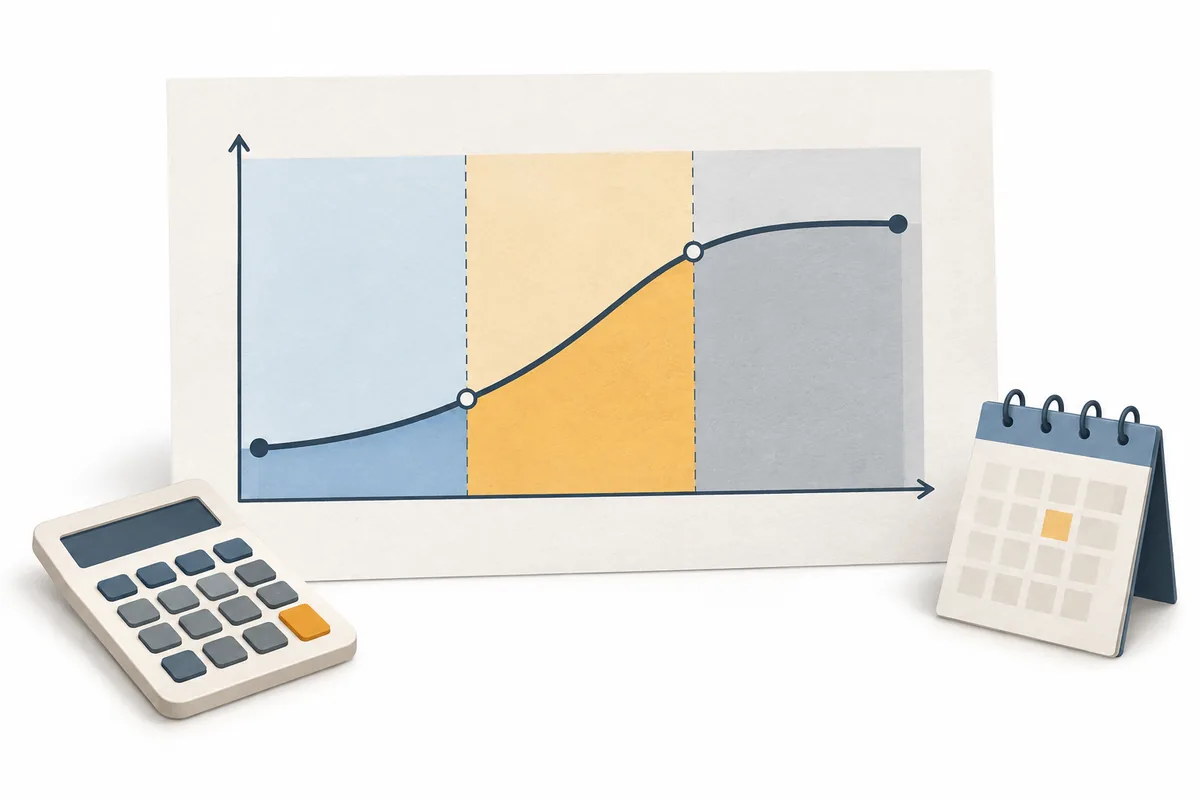
A phase-out gradually reduces the amount you may contribute directly to a Roth IRA. It is based on modified adjusted gross income and filing status, not simply on salary. Below the lower threshold, a person who passes the compensation test can generally make the full annual contribution. Inside the range, the permitted amount shrinks. At or above the upper threshold, a direct Roth contribution is not available under the standard rule.
Married Filing Separately is a special case when the taxpayer lived with a spouse during the year. Its range is much narrower than the single and joint ranges. If you are unsure whether the special MFS rule applies, do not rely on a calculator result alone; review the IRS worksheet or ask a qualified tax professional.
| Filing status | Phase-out begins | Direct contribution fully phased out |
|---|---|---|
| Single or head of household | $153,000 MAGI | $168,000 MAGI |
| Married filing jointly or qualifying widow(er) | $242,000 MAGI | $252,000 MAGI |
| Married filing separately and lived with spouse | $0 MAGI | $10,000 MAGI |
THE INCOME NUMBER
How modified AGI changes the calculation
Modified adjusted gross income, or MAGI, is the number used for the Roth income test. It begins with adjusted gross income and adds back specific items listed in the IRS rules. For many households, MAGI and AGI are close, but they are not automatically interchangeable. A traditional IRA deduction, certain foreign income exclusions, student loan interest and other adjustments can matter.
Use the best supported estimate you have for the selected tax year. Do not replace MAGI with gross pay just because gross pay is easier to find. If your income is near a threshold, a small change can move the result from full contribution to partial contribution or no direct contribution. Keep the inputs and the source of your estimate with your tax records.
- Choose the filing status: Select single, head of household, joint, qualifying surviving spouse or the applicable MFS situation.
- Estimate MAGI: Use a tax-aware estimate rather than a monthly paycheck total or a household guess.
- Check the range: Compare MAGI with the lower and upper thresholds for the tax year.
- Reduce for other deposits: Subtract traditional IRA contributions from the shared annual pool before planning the Roth amount.
TIMING
Contribution deadlines, age and compensation
A contribution for a tax year is usually allowed until the federal tax-filing deadline for the following year. For example, a 2026 contribution is generally due by April 15, 2027, unless the IRS changes the date for a specific reason. The custodian must receive the contribution and code it for the correct tax year. Filing an extension generally does not extend the IRA contribution deadline.
There is no upper age limit for regular Roth IRA contributions when you have qualifying compensation. The age-50 rule adds catch-up room; it does not remove the compensation or income tests. If you are contributing for a spouse, a joint return and enough combined compensation can support a spousal IRA contribution, but the household still needs to follow the shared compensation rules.
WORKED SCENARIOS
Three examples that prevent common misunderstandings
Example one: a 35-year-old single filer has $100,000 of MAGI, $100,000 of taxable compensation and no other IRA contribution. The person is below the 2026 single phase-out range, so the starting contribution room is the full $7,500, subject to the final tax facts and account processing.
Example two: a 40-year-old single filer has $160,000 of MAGI and enough compensation. The income falls inside the $153,000–$168,000 range. The direct Roth amount is reduced rather than automatically set to zero. The exact calculation uses the IRS worksheet and rounding rules; a simplified web estimate should be treated as directional.
| Scenario | What changes | What to check next |
|---|---|---|
| Low income | Compensation is $4,000 | The compensation cap limits total IRA deposits to $4,000. |
| Middle of phase-out | MAGI is inside the filing-status range | Use the official worksheet for the reduced amount. |
| Other IRA deposit | $3,000 already went to a traditional IRA | Only the remaining shared room can go to Roth. |
BEFORE YOU CONTRIBUTE
Common mistakes to avoid
The most expensive errors are usually classification errors: treating the limit as per account, using gross income instead of MAGI, ignoring the compensation cap, or choosing the wrong tax year with a custodian. These mistakes can create an excess contribution that requires correction and may have tax consequences.
Use the checklist below as a review prompt, not as a substitute for the IRS instructions. If your facts include a conversion, rollover, inherited IRA, recharacterization, self-employment income, multiple employers or a filing-status change, get a professional review before acting.
- Do not multiply the annual limit by the number of traditional and Roth accounts you own.
- Do not assume a high salary equals MAGI or that a bonus belongs to the same tax year as the contribution.
- Do not treat a Roth conversion or rollover as additional annual contribution space.
- Do not use the single range when you file jointly or separately.
- Do not wait until the deadline without confirming the contribution year with the custodian.
- Do not treat a planning calculator as proof that a contribution is allowed.
COMMON QUESTIONS
Roth IRA contribution limits FAQ
These short answers clarify the rules most often confused with the headline annual limit.
What is the Roth IRA contribution limit for 2026?
The combined annual limit for traditional and Roth IRAs is $7,500, or $8,600 for someone age 50 or older. Taxable compensation and Roth income phase-outs can reduce the amount you may deposit directly.
Can I contribute $7,500 to a Roth IRA and another $7,500 to a traditional IRA?
No. The annual IRA limit is shared across both account types. Deposits to one account reduce the remaining room in the other account.
What is the 2026 Roth IRA income limit for a single filer?
The direct contribution phase-out for single and head-of-household filers begins at $153,000 of MAGI and ends at $168,000. Inside that range, the allowed amount is reduced.
How long do I have to make a 2026 Roth IRA contribution?
The usual deadline is April 15, 2027, but confirm the date and tax-year coding with the IRS and your custodian. An extension to file a tax return generally does not extend the IRA contribution deadline.
Is a Roth conversion counted against the annual contribution limit?
A conversion is a different transaction from a regular contribution. It is not extra contribution room, and it can create taxable income. This guide does not calculate conversion tax.
Check the rule, then test your savings plan
Use the calculator to model a contribution and growth scenario, keep the selected tax year visible, and verify your final amount with current IRS guidance or a qualified tax professional before you contribute.
Open the Roth IRA calculator